A Whiteparish local history page from younsmere-frustfield.org.uk
This page lists all references relating to the Stockman family in Whiteparish/Frustfield between pre-1619 and 1688, with comments and assessments of the reliability of each source and/or entry.
Work continues on this page, adding further references and detail, as well as providing direct links to all material referenced and cross-checking the accuracy of my own statements - treat with caution until complete, when I will remove this statement. Still being updated several times each day on 16.1.2023.
This page considers the accuracy of selected references. For full accounts of the family and their undertakings, see
The Stockman family bought, developed and sold various key pieces of land in Whiteparish from shortly before 1619 to 1688. The literature on this family has collected a number of errors along the way, and this page works outward from Matcham's 1844 book Hundred of Frustfield to attempt to identify where these occurred and to set the family and their land dealings into the right context. In writing his comprehensive account of the Hundred, Matcham had access to the family papers of all the large landowners in the parish, so despite one or two small slips discussed on this page, appears to have given a reliable summary of land dealings from the original deeds and documents.
Unlike many of the landowners that feature in the history of Frustfield and Whiteparish, each of which was established on an estate for a number of years and had a collection of family papers that they made accessible to Matcham, the Stockman family was based out of the Hundred/Parish at Barford House (Downton, Wilts) and did not have a long term family address within the parish. Their purchases and sales can't be followed quite as easily, especially as only three generations of the family were involved and as Barford House no longer exists (although the park does and still contains Barford Farm). In researching the history of the various related Whiteparish estates, the Stockman family members crop up briefly, but are not always consistently recorded from one estate to another. This page is an attempt to construct a single clear narrative linking their land dealings.
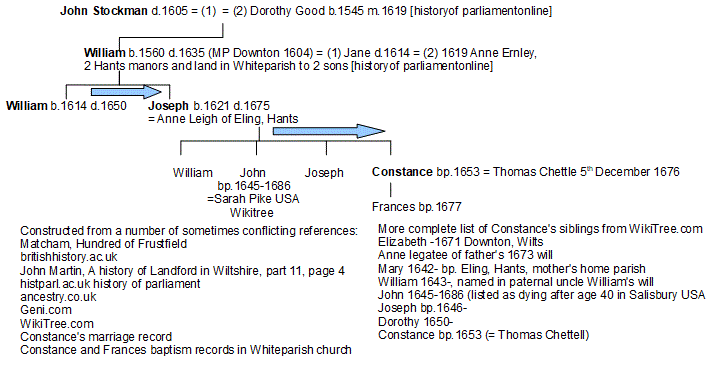
For clarity, individual members of the Stockman family are labelled on this page to show the generations, from John 0 through his son William 1, his sons William 2 and Joseph 2, Joseph's daughter Constance 3 and her daughter Frances 4. With the exception of Frances 4, these were the Stockman family members who at some time each owned land in the parish.
I have used the modern spelling of Titchborne on this page, this differing from the several alternative spellings used by Matcham in his 1844 book quoted and an even wider variety of spellings in preserved original documents.
In no particular order:
The key differences found in the literature are as follows:
All these points are clarified and elaborated in the discussion on this page.
Particular errors and inconsistencies noted are as follows:
I'm still adding material to this page, so in due course all sources listed above will be covered in detail.
After detailed analysis, the key players in the Stockman story are as follows:
[Another point to check - there is a William 3 and Joseph 3 recorded on this family tree - make sure that these couldn't have been any of the Williams/Josephs in the references. Since there is only a year between Joseph 2's death in 1676 and Constance Stockman (and her husband Thomas Chettell) selling Titchborne Farm in 1677, this does seem very unlikely. The likelihood is that William 3 and Joseph 3 either predeceased their father or were given other land elsewhere, and that Constance 3 inherited Titchborne Farm directly from Joseph 2. Work is continuing to check this point.]
The basic line of inheritance was from John of Barford to William 1, from him to his sons William 2 and Joseph 2, with William 2's land also passing in 1650 to his brother Joseph 2. Finally, the family's remaining land passed from Joseph 2 to his daughter Constance 3. A year after Joseph 2's death, in 1676, Constance married Thomas Chettell, and I couldn't resist putting in their first born child Frances, even though her parents sold all the remaining Stockman property in the parish by 1688.
The entries listed here come from three generations of the Stockman family and cover all four generations when the parents are considered too. The first two entries are sons of William 1. The next three are children of Joseph 2. In the last entry, Frances 4 is the daughter of Joseph 2's daughter Constance 3 and her husband Thomas Chettell.


1595 Edward 2, 1596 John 2, sons of William 1


1643 William 3, 1646 Joseph 3, 1653 Constance 3, children of Joseph 2

1677 Frances, daughter of Constance (Stockman) 3 and Thomas Chettell
This is the Marriage Licence of Constance Stockman and Thomas Chettle. This reference isn't from Matcham, but helps to resolve the discrepancy where some references list Constance as Joseph's daughter while others list her as Joseph's widow. Although she styles herself Mrs (Mistress at that date), she is a spinster, and her age is correct for Joseph's daughter listed in the baptisms above. This confirms that Constance was not Joseph's widow but his daughter. The birth of their first child, Frances in the following year, 1677, is the last baptism I've listed above.
The Victoria County History appears to be the origin of the incorrect representation of Constance Stockman as Joseph's widow when she married Thomas Chettell in 1676, a year after her father's death.
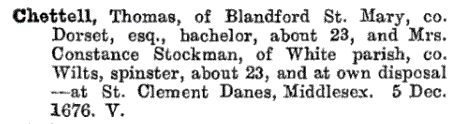
Marriage of Mrs Constance Stockman to Thomas Chettle, 5th December 1676
Google Books London marriage licences 1521-1869, Joseph Foster, Joseph Lemuel Chester, John Ward Dean, Dalcassian Publishing Company, 1 Jan 1887, London.
This entry is on p.275 and in the index on p.1585
The extract of the 1842 Tithe Map coloured according to land occupiers below will help in following the purchase and division of Titchborne Manor (earlier known as Abbotstone Manor) described in the references below into Newhouse (1619), Dry Farm (1646) and Titchborne Farm (the remainder). These three areas lie along the bottom of this map along the western boundary of the parish of Whiteparish parish and of the Hundred of Frustfield (north is to the left of this map). The small area of Titchborne Farm coloured pink was church property, as was the small pink adjacent area of Moor manor, presumably land that had been given to the church, and the bright blue area in the adjacent manor of Moor was property of the Abbotstone chapel of St James at Moor seized by Henry VIII in 1546 at the dissolution and sold to William St Barbe. Pink on this map identifies land occupied in 1842 (and in most cases also owned) by Horatio, Earl Nelson, so the other pink areas on the map aren't associated with these church lands.
.gif)
The 1842 Tithe map, here coloured by occupiers, illustrates the three parts of the manor that crop up below:
Dry Farm - grey at bottom left; Titchborne Farm - buff at bottom centre; the Whiteparish part of the Newhouse estate - red at bottom right
This map needs updating - I no longer agree with Taylor's land areas indicated from the 943 and 968 Saxon charters. See Saxon Charters for a full discussion.
This entry shows that by 1619 William 1 had already established the park and built the house now known as Newhouse on part of Titchborne manor. He had earlier (1601-1609) built Hamptworth Lodge and sold it with an estate of 22 acres carved out of common land there [Landford History and select Part 11 Hamptworth Lodge]. Here, he included in the sale not only land in Titchborne Manor, but to enlarge the estate, also land he owned in the neighbouring parish of Downton (now Redlynch).
.gif)

William 1 is likely be the freeholder listed here of two pieces of land in Whelpley manor (unless there were two William Stockmans or putting the name twice was a typo on Matcham's part). It seems likely that one of these pieces of land was Chadwell Farm, given to charity in 1626 (see below). Further investigation is under way. [Matcham page 43]

Whelpley Freeholders in 1622
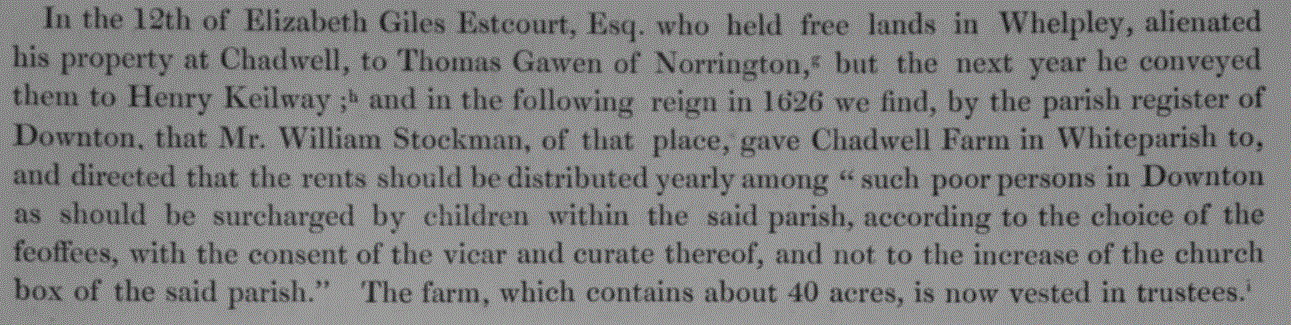
[12 Elizabeth 1558+12~1570.] The 1626 donor was William 1. This is a year before his purchase of Whelpley Farm in 1627 and implies that William 1 had already purchased other land here in Whelpley manor. Most of the land in the south of Whelpley manor is divided into similar areas and these may have been some of the ancient freehold properties referred to by Matcham [Matcham page 43], where William Stockman is listed twice. Chadwell Farm is not adjacent to either Titchborne Farm or Whelpley Farm, although it is not impossible that this land came with one of those purchases, more likely the one that definitely predated this entry (Titchborne manor).
This entry is at odds with Matcham page 39 (see below), which says that William 1 purchased Whelpley Farm, not Joseph. Clearly Joseph 2 would have been too young at this date (age 6). It is not impossible for William 1 to have had a brother Joseph 1, but I have found no mention of such, so as stated on page 39, William 1 seems the most probable purchaser, not Joseph as stated here. Part of William 1's property passed to his son William 2 in 1635 (when William 2 was aged 21), the rest to William 2's brother Joseph 2, who also gained William 2's property in 1650, and to Constance 3 in 1675, so Whelpley Farm had been owned by Joseph 2, possibly the source of the confusion here.

A Mistress Stockman, widow, in Whelpley (tithing); and Joseph Stockman in Abbotstone (tithing) occur in the list of people liable to pay the Frustfield rate for ship money in 1836. £2/5/0d is a significant sum, the second largest taxpayer in Whelpley and a sixth of the total £15/5/2d paid by the 29 people liable in the tithing. William 1 died in 1635 so his wife Anne (nee Earnley) would almost certainly be this lady. At this date she would have owned Whelpley Farm, which explains the large sum. William had

.gif)

Dry Farm is the opposite end of Titchborne Manor from Newhouse. The purchaser here is William 1. From him it descended first to his son William 2, then from him to another son and William 2's brother, Joseph 2, the seller, in 1650.

William 1 had given one of his 1622 freehold pieces of land in Whelpley manor to charity in 1626 (Chadwell Farm). William 1 died in 1635 and William 2 in 1650, so Joseph Stockman is probably the owner of William Stockman 2's land in 1657. This entry lists William Stockman as a freeholder in 1657 - could this be an error by Matcham, by his source, or another William Stockman? [Work is under way to resolve this, and this entry will then be updated.] Although this might be Whelpley Farm, the list of "freehold" properties probably only included early freeholds and not recent purchases, effectively outside the manorial system, such as Whelpley Farm. It is therefore more likely that this is the second freehold listed under 1622 and therefore elsewhere in the manor. Experience suggests that this will probably be one of the separate farms in the south of the manor towards the A36.

Whelpley Freeholders in 1657
Matcham records a note about church lands in the Brickworth papers, to which he had access when writing his book "Hundred of Frustfield". These record that a number of specific small parcels of land had been set apart before the Dissolution by Queen Elizabeth for the support of the fabric of the [presumably Whiteparish] church. It was claimed that these had been 'appropriated' by named individuals and now, following the restoration of the monarchy, should be reasserted as church property. Mr Stockman is recorded as a proposed new feoffee [explain]. The outcome of this application to the Commissioners was not known to Matcham, so was not recorded. At this date this would have been Joseph Stockman 2. [I am continuing to compare the list of pieces of land with ownership in 1842 on the Tithe map, which should help to resolve what the outcome was - to be added here when complete.]

These maps date from much later (1842 Tithe map), but are instructive here in that they show what is likely to be a much earlier division of the southern part of Whelpley Manor into freeholds. The left map shows landowners and the right map shows occupiers. To the north (left of these maps) lay the four commonable arable fields, the final stage of their enclosure being recorded in the 1804 Tithe Commutation Award. One key area of interest here is Chadwell Farm, given in 1626 by William 1 to charity [replace with proper attribution]. This shows prominently in red on these two maps, labelled on the right hand one. It seems very possible that William 1's other freehold property of 1622 lay in this area, this plausibly also being the property listed in 1657, probably for Joseph Stockman 2, as well as the 1636 charge on William 1's widow for ship money. I'm continuing to explore values and other records to attempt the identification of this piece of land, and updates will continue to appear online as this work proceeds [updates to this page occurring several times each day as of 12.1.2023].
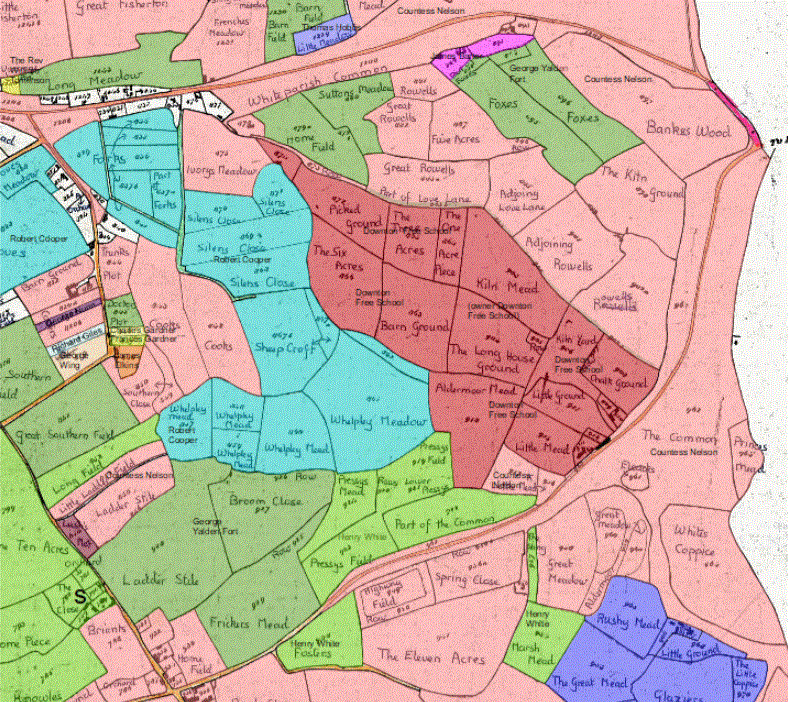

The southern end of Whelpley Manor in 1842. Left: owners; Right: occupiers
North is to the left on this map
As mentioned above under page 51-52, William 1 must have bought Titchborne manor at a date sufficiently before 1619 to have been able to have Newhouse built and develop Titchborne Park around it ready for sale in 1619. The probable solution to Matcham's dilemma here ('... but it evidently reverted to the family...') is that William 1 retained the manor in the 1619 sale of Titchborne Park/Newhouse and that it subsequently passed, as Titchborne Farm, through William 2 and Joseph 2 to Constance 3. As well as Newhouse at the southeast end of Titchborne Manor, Dry Farm at the northwest end of the manor had earlier been sold in 1646 by Joseph 2 (see above), leaving just the core of the manor as Tichborne Farm. The sale in 1677 by Thomas Chettell and Constance 3 (Stockman) his wife is in the year after their marriage. Their first child Frances was baptised in Whiteparish, also in 1677, but this sale in 1677 and that of Whelpley Farm in 1688 suggests they subsequently moved elsewhere. It seems likely that Thomas may have inherited land in Blandford St Mary, Dorset, but I have yet to check on this possibility.
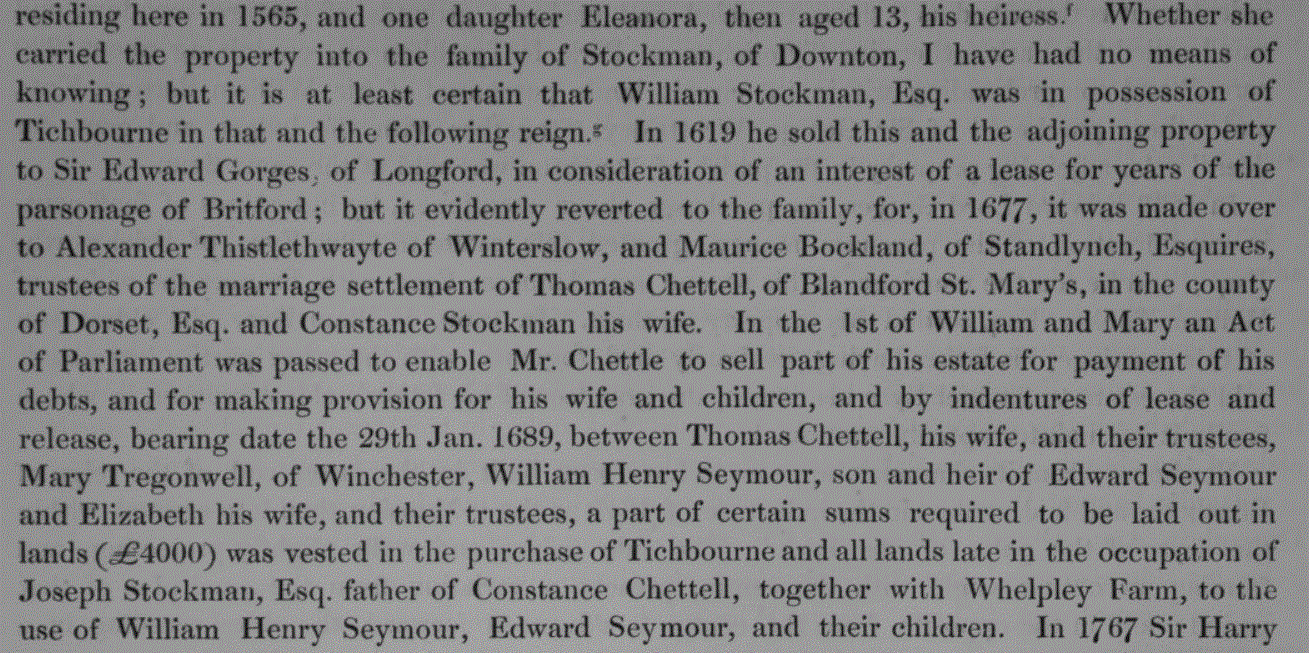
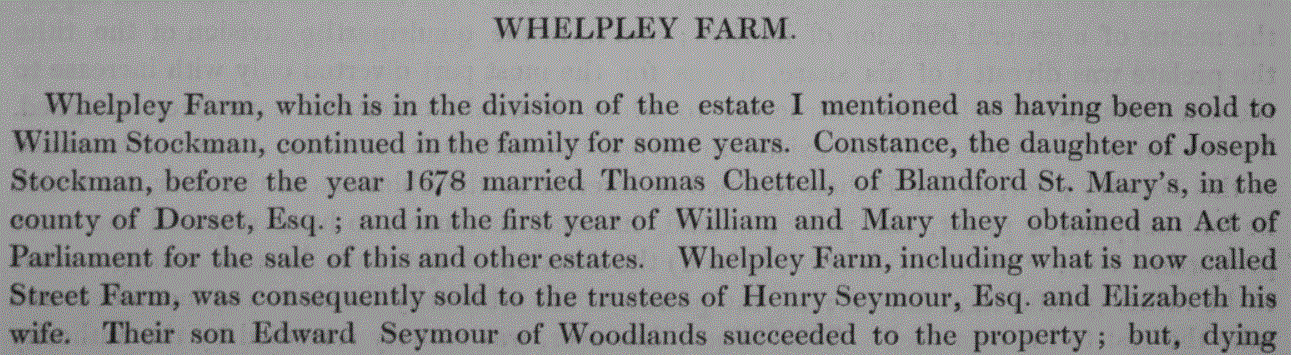
This entry is at odds with page 19, where Matcham refers to Joseph, not William as the original purchaser. As discussed above in that entry, William 1 is the probable purchaser of Whelpley Farm. William 2 inherited property from his father and passed it to his brother Joseph 2 on his death in 1650. See the notes about page 19 above; William 1 seems the most probable purchaser here. Constance's wedding, here as 'before 1678' took place on 5th December 1676 (see her marriage licence above). 1 William & Mary is 1688.